

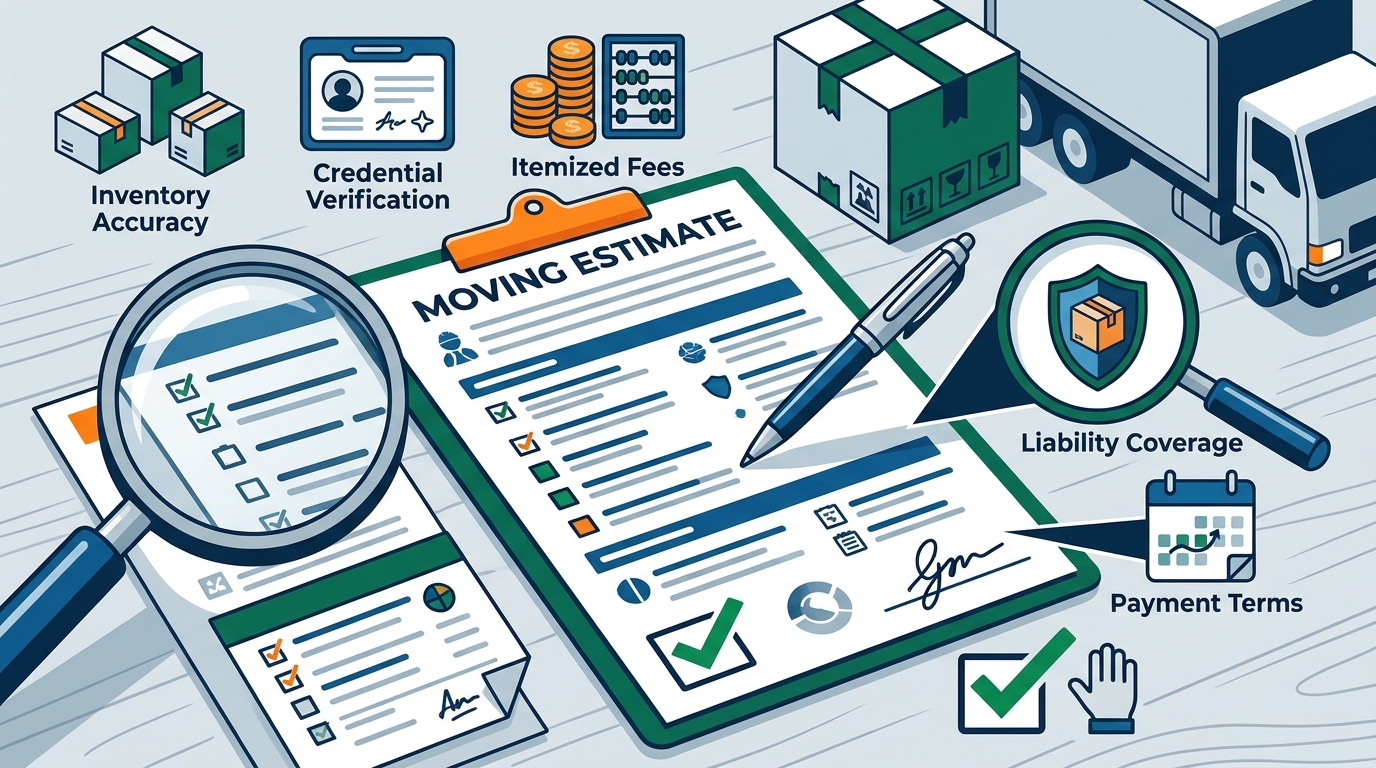
Before signing a moving contract, you must verify the estimate type, company credentials, inventory accuracy, itemized fees, liability coverage, and payment terms. This guide provides a detailed checklist to ensure your quote is transparent and legally binding. Big Gunz Movers & Home Improvement in Dallas, TX, uses these standards to protect clients during local and long-distance relocations.
Estimate Type
The first step in verifying a quote is identifying the type of estimate provided. A moving estimate is a document that predicts the cost of a move based on specific variables. There are three primary types: binding, non-binding, and binding not-to-exceed.
Binding Estimates
A binding estimate guarantees the price quoted at the time of the estimate. The final cost will not change regardless of the actual weight or volume of the goods, provided the inventory remains the same. This type offers the highest level of financial certainty for the customer.
Non-Binding Estimates
A non-binding estimate is a good-faith estimate based on the customer's description of their goods. The final price is determined by the actual weight and volume of the items moved. If the actual weight exceeds the estimate, the customer pays the difference. This type is common for long-distance moves where a physical inventory is not conducted.
Binding Not-to-Exceed Estimates
A binding not-to-exceed estimate guarantees that the final price will not exceed the quoted amount. If the actual cost is lower, the customer pays the lower amount. This type provides a price ceiling, protecting the customer from unexpected overages.
Company Credentials
Verifying company credentials ensures you are hiring a legitimate and insured moving company. A licensed moving company is a business that has met the regulatory requirements to operate in a specific jurisdiction. In Texas, local movers must be licensed by the Texas Department of Transportation (TxDOT).
DOT and MC Numbers
For interstate moves, the company must have a valid USDOT number and an MC (Motor Carrier) number. These numbers are issued by the Federal Motor Carrier Safety Administration (FMCSA). You can verify these numbers on the FMCSA SaferWatch database to ensure the company is in good standing and has no serious safety violations.
Insurance and Bonding
A reputable moving company carries liability insurance and may be bonded. Liability insurance covers damage to your goods during the move. Bonding provides financial protection against theft or fraud. Verify that the company provides a certificate of insurance upon request.
Inventory Accuracy
Inventory accuracy is the foundation of any moving quote. An inventory list is a detailed record of all items to be moved, including their quantity, condition, and value. Inaccurate inventories lead to disputes over weight and value.
Physical Inventory
A physical inventory is conducted by a mover who visits your home to measure and list your items. This method provides the most accurate estimate. The mover records the dimensions and weight of each item, as well as its condition. This is the gold standard for binding estimates.
Customer-Provided Inventory
If a physical inventory is not conducted, the mover relies on a customer-provided inventory. This list is created by the customer and is less accurate. It is typically used for non-binding estimates. Ensure that your list is as detailed as possible, including the number of boxes, furniture pieces, and appliances.
Itemized Fees
Itemized fees break down the total cost of the move into specific charges. An itemized fee schedule is a list of all charges associated with the move, including labor, fuel, and equipment. Hidden fees are a common source of disputes. Verify that all potential charges are listed in the quote.
Common Moving Fees
Special Handling Fees
Special handling fees apply to items that require extra care, such as pianos, antiques, or large appliances. These fees are often charged per item. Verify that the quote includes a list of items that require special handling and the associated costs.
Liability Coverage
Liability coverage is the legal responsibility of the moving company for damage to your goods during the move. A liability coverage plan is a policy that specifies the amount of compensation the mover will pay for damaged or lost items. There are two primary types of liability coverage: full value protection and released value protection.
Full Value Protection
Released Value Protection
Payment Terms
Payment terms define when and how you pay for the move. A payment schedule is a plan that outlines the timing and method of payments. Understanding payment terms helps you manage your cash flow and avoid unexpected charges.
Deposit Requirements
Many moving companies require a deposit to secure your booking date. The deposit is typically a percentage of the total estimate. Verify the amount of the deposit and whether it is refundable. A refundable deposit is returned if you cancel the move for a valid reason.
Final Payment
The final payment is due upon completion of the move. For non-binding estimates, the final payment is based on the actual weight and volume of the goods. Verify the method of payment, such as cash, check, or credit card. Some companies charge a fee for credit card payments.
Comparison Table
| Estimate Type | Price Certainty | Inventory Requirement | Best For |
|---|---|---|---|
| Binding | High | Physical Inventory | Long-distance moves |
| Non-Binding | Low | Customer-Provided | Local moves |
| Binding Not-to-Exceed | Medium | Physical Inventory | Budget-conscious customers |
Key Takeaways
- Always verify the type of estimate (binding, non-binding, or binding not-to-exceed) to understand your financial risk.
- Check the company's DOT and MC numbers on the FMCSA SaferWatch database to ensure they are licensed and in good standing.
- Request a physical inventory for the most accurate quote, especially for long-distance moves.
- Review the itemized fee schedule to identify and avoid hidden charges.
- Understand the difference between full value protection and released value protection liability coverage.
- Clarify payment terms, including deposit requirements and final payment methods.
- Keep a copy of the signed contract and all correspondence with the moving company.
- Report any damage or loss immediately and file a claim within the specified timeframe.
Frequently Asked Questions
What is the difference between a binding and non-binding estimate?
A binding estimate guarantees the price quoted, while a non-binding estimate is a good-faith estimate that may change based on actual weight and volume.
How do I verify a moving company's license?
You can verify a moving company's license by checking their USDOT and MC numbers on the FMCSA SaferWatch database.
What is released value protection?
Released value protection is the minimum liability coverage required by federal law, which covers 60 cents per pound per article.
Do I need full value protection?
Full value protection is recommended for high-value items, as it covers the full replacement value of your goods if they are damaged or lost.
What is a physical inventory?
A physical inventory is a detailed record of all items to be moved, created by a mover who visits your home to measure and list your items.
How much is a typical moving deposit?
A typical moving deposit is a percentage of the total estimate, often ranging from 10% to 50%.
What should I do if my items are damaged during the move?
Report the damage immediately to the moving company and file a claim within the specified timeframe, usually within 9 months for interstate moves.
Conclusion
Verifying a moving company quote is a critical step in ensuring a smooth and stress-free relocation. By checking the estimate type, company credentials, inventory accuracy, itemized fees, liability coverage, and payment terms, you can protect yourself from unexpected costs and disputes. Big Gunz Movers & Home Improvement is committed to providing transparent and accurate quotes for all our clients. To plan your move, today.