

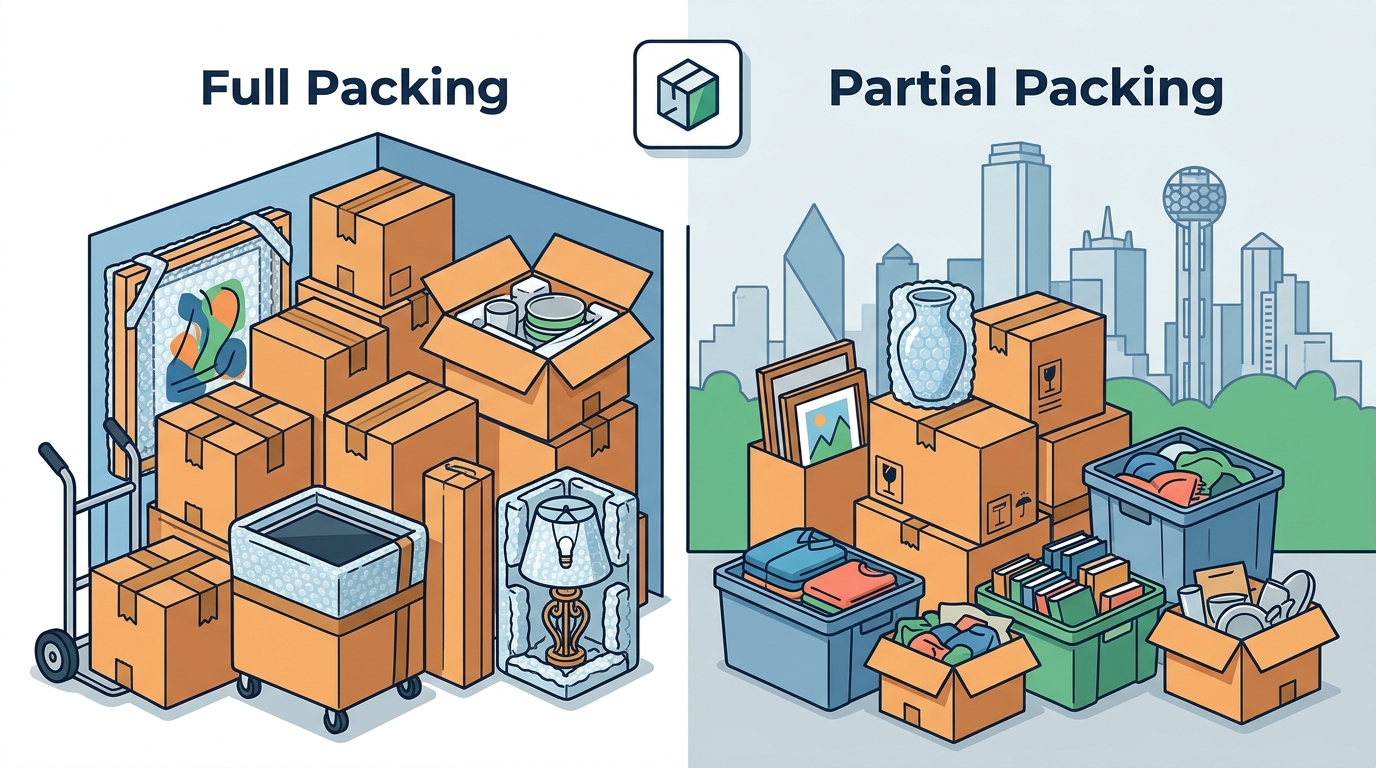
For most studio apartment moves, partial packing is the better choice because it balances cost savings with professional protection for fragile items. Full packing is only worth the premium if you have zero time to pack or require white-glove service for high-value assets. This guide compares the two approaches for Dallas residents, analyzing costs, fragile item handling, time constraints, and DIY strategies to help you decide what fits your specific move profile. For additional details, review the Big Gunz Movers amp.
Cost Comparison: Full vs. Partial
Understanding the financial difference between service levels is the first step in budgeting your move. Full packing is a service where the moving company packs every single item in your residence, including clothing, books, and kitchenware. Partial packing is a service where the movers pack only high-value or fragile items, such as electronics, glassware, and artwork, while you handle the rest. For a typical studio apartment in Dallas, the square footage is usually between 400 and 600 square feet. This limited space means the total volume of goods is lower than a two-bedroom unit, which significantly impacts the labor hours required for packing.
Material and Labor Costs
When you choose full packing, you are paying for two distinct resources: labor and materials. The movers must bring in boxes, bubble wrap, tape, and padding for every item. In a studio, this can mean 30 to 50 boxes. If you choose partial packing, you are responsible for sourcing your own boxes for non-fragile items. You can often find free boxes from local businesses or use reusable totes, which reduces the material cost to near zero for the bulk of your belongings. The labor cost for full packing in a studio can add several hundred dollars to the base moving quote. This premium covers the time it takes the crew to pack, label, and organize your entire home before loading the truck.
Value Assessment
Fragile Item Handling Protocols
Fragile items are the primary reason people hire professional packers. These items require specific techniques to prevent breakage during transit. Fragile item handling is the process of using specialized materials and methods to protect breakable goods from impact and vibration. In a studio apartment, space is tight, which means fragile items are often stored in awkward locations. This increases the risk of accidental drops during the packing process. Professional movers are trained to identify these risks and mitigate them using industry-standard protocols.
Electronics and Appliances
Televisions, computers, and small appliances like microwaves and dishwashers require specific care. Movers use double-boxing techniques for large screens, where the TV is placed in a box, padded with foam, and then placed inside a second, larger box. This creates a buffer zone that absorbs shock. For appliances, movers disconnect and secure hoses and cords to prevent leaks or electrical damage. If you choose partial packing, ensure the crew handles these specific items. You should not attempt to pack a large TV yourself unless you have the correct materials and experience. The risk of a cracked screen is not worth the savings on labor for this specific category of items.
Glassware and Kitchenware
Studios often have limited kitchen space, meaning you may have a smaller collection of glassware than a larger home. However, the items you do have are likely your daily essentials. Movers use dividers and bubble wrap to separate each piece of glass. They pack plates vertically in boxes with padding between each layer. This prevents the plates from sliding and chipping against each other. If you opt for DIY packing, you must replicate this method. Use towels or newspaper to wrap each item individually. Place them in a box with a layer of padding at the bottom. Do not overfill the box, as this increases the pressure on the items inside. Label these boxes clearly as "FRAGILE" on all sides to alert the loading crew.
Time Constraints and Scheduling
Your available time is a critical factor in choosing between full and partial packing. Moving is a logistical challenge that requires coordination. Time constraints in moving refer to the limited window you have to complete packing, loading, and unloading before your lease expires or your new lease begins. In Dallas, moving days are often scheduled on weekends, which are the most popular times for movers. This high demand can lead to scheduling conflicts if you are not prepared. If you have only two or three days before your move, full packing is the safer option. It eliminates the need for you to spend your entire weekend packing. You can focus on other tasks, such as updating your address or setting up utilities.
The Weekend Crunch
Many residents underestimate the time it takes to pack a studio. A 500-square-foot studio can take 10 to 15 hours to pack completely. If you are working full-time, this is a significant time commitment. You may need to take time off work or use your entire weekend. If you choose partial packing, you must plan your DIY packing schedule carefully. Start packing at least two weeks in advance. Focus on items you do not use daily, such as books, seasonal clothing, and decor. This spreads the workload over several weeks, reducing the stress of the final days. By the time the movers arrive, you will have only a few boxes left to pack. This approach allows you to maintain your normal routine while preparing for the move.
Professional Efficiency
Professional movers are efficient because they work as a team. Two or three movers can pack a studio in a fraction of the time it would take one person. They have the experience to know how to pack items quickly and securely. If you are short on time, this efficiency is a major advantage. You do not have to worry about running out of time or making mistakes. The movers handle the entire process from start to finish. This is particularly useful if you are moving during a busy season, such as summer or the end of the month. Scheduling a full packing service ensures that your move is completed on time, regardless of external factors.
DIY Packing Strategy for Studios
If you choose partial packing, you need a solid strategy for handling the items the movers will not pack. A structured approach ensures you do not miss anything and that your boxes are organized for easy unpacking. DIY packing strategy is a systematic method for packing your belongings using your own labor and materials. The goal is to maximize efficiency and minimize the risk of damage. Start by creating a master list of all your items. This list helps you track what you have packed and what is still left. It also serves as an inventory for your insurance claim if anything is lost or damaged.
Room-by-Room Approach
Even in a studio, it helps to divide your space into zones. Create zones for the kitchen, bedroom, living area, and bathroom. Pack one zone at a time. This prevents you from feeling overwhelmed. Start with the zone you use the least. For many people, this is the storage area or the closet. Pack these items first and label the boxes with the room they belong to. This makes unpacking much easier. You can simply carry the boxes to the correct room in your new studio. Do not mix items from different rooms in the same box. This creates confusion during the unpacking process. Keep your daily essentials in a separate, clearly labeled box. This box should contain toiletries, chargers, medications, and a change of clothes. Keep this box with you, not in the moving truck. This ensures you have what you need on the first night in your new home.
Labeling and Organization
Labeling is the most important part of DIY packing. Use a marker to write the room name and a brief description of the contents on the side of the box. For example, write "Kitchen - Plates" or "Bedroom - Winter Clothes." This allows you to find specific items quickly without opening every box. You can also use a color-coding system. Assign a color to each room. Use blue tape for the kitchen, red for the bedroom, and green for the living area. This visual cue helps you organize the boxes in the truck and in your new home. Big Gunz Movers & Home Improvement can provide you with labels and markers if you request them as part of your partial packing service. This small addition can make a big difference in your organization.
Key Takeaways
- Partial packing is generally more cost-effective for studio moves, as you only pay for professional handling of fragile items.
- Full packing is worth the premium if you have very little time or high-value items that require white-glove service.
- Fragile items like TVs and glassware should always be handled by professionals to minimize the risk of damage.
- Start your DIY packing at least two weeks in advance to avoid last-minute stress.
- Use a room-by-room approach and clear labeling to make unpacking faster and easier.
- Keep a "first night" box with essentials that you do not put in the moving truck.
- Verify your insurance coverage for items you pack yourself, as some policies have lower limits for DIY-packed goods.
- Communicate your specific needs to your moving company to ensure they bring the right materials for your partial packing request.
Frequently Asked Questions
How much does full packing cost for a studio apartment?
The cost of full packing for a studio apartment varies based on the volume of items and the moving company. In Dallas, you can expect to pay a premium over the base moving rate. This premium covers the labor and materials required to pack every item. For a typical studio, this can add several hundred dollars to your total moving cost. It is best to request a detailed quote from your mover to understand the exact cost for your specific situation.
What items should I definitely have packed by professionals?
Can I switch from partial to full packing on the day of the move?
It is possible to switch from partial to full packing on the day of the move, but it may affect your schedule and cost. The movers may need to bring additional materials and labor to your home. This can cause delays in the loading process. It is best to decide on your packing level in advance and communicate your choice to the moving company. If you change your mind, contact them as early as possible to discuss the implications.
Do I need to buy my own boxes for partial packing?
Yes, if you choose partial packing, you are responsible for providing boxes for the items you pack yourself. You can buy new boxes or find used ones from local businesses. Ensure the boxes are in good condition and the right size for your items. You can also ask your moving company if they sell boxes. This is often a convenient option, as the boxes are designed to fit their trucks and are durable enough for the move.
How do I insure items I pack myself?
Items you pack yourself are typically covered under the basic liability protection included in your moving quote. This coverage is usually limited to a small amount per pound. If you have high-value items that you pack yourself, you may want to purchase additional insurance. This provides higher coverage in case of damage or loss. Check with your moving company to understand the details of their insurance options and how they apply to DIY-packed items.
Is it better to pack clothes in boxes or bags?
For a studio move, bags are often more efficient for clothes. You can pack more clothes in a bag than in a box, and bags are easier to carry. However, boxes provide better protection for delicate items like silk or wool. You can use a combination of both. Pack sturdy clothes in bags and delicate items in boxes. Label the bags clearly so you know what is inside. This approach maximizes space in your moving truck.
What should I do with my plants on moving day?
Plants are sensitive to changes in temperature and light. It is best to keep them in your car on moving day if possible. If you must put them in the moving truck, ensure the truck is climate-controlled. Water your plants the day before the move to help them withstand the stress. Place them in a secure spot in the truck where they will not be crushed. Unpack them as soon as you arrive at your new home and place them in a bright area.